
EEG Test: Price, Purpose, Procedure, Preparation & Risks [2026]
An EEG test or electroencephalography is a test that measures electrical activity in the brain. Doctors often recommend it to detect conditions like epilepsy, sleep disorders, head injuries, and other neurological issues. The test helps in identifying abnormal brain wave patterns that may indicate underlying health concerns. EEG test price ranges from Rs 1500 to Rs 2500 in India.
Our brain consists of billions of nerve cells called neurons. These neurons interact with each other through electrical signals. These signals appear as wave patterns on an EEG test. An abnormal wave pattern may be present in neurological disorders like epilepsy.
Test details in brief
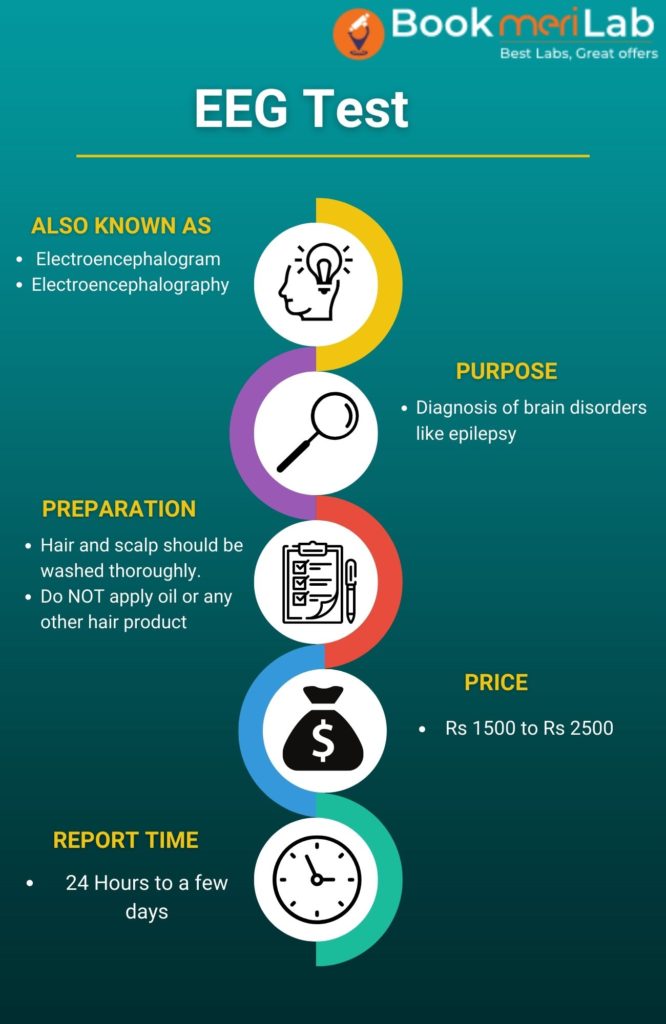
| Also known as | Electroencephalogram, electroencephalography |
| Purpose | Diagnosis of brain disorders like epilepsy |
| Preparation | Hair and scalp should be washed thoroughly. Do not apply oil or any other hair product |
| Cost | Rs 1500- Rs 2500 |
| Duration | 45 minutes to 2 hours |
| Reporting time | 24 hours to a few days |
EEG Test Cost
The EEG test price in India typically ranges from Rs 1500 to Rs 2500. The actual price depends on the diagnostic center and the city. In government hospitals or labs, the cost may be lower, while private diagnostic centers may charge higher based on advanced technology and facilities.
At Bookmerilab, we partner with 200+ diagnostic centers across India, offering discounts between 10-50% on EEG tests, ensuring affordability without compromising on quality.
The table below lists the EEG prices at a few popular diagnostic centres
| Name of Lab | Test Price |
|---|---|
| Aarthi Scans | Rs 1400 |
| Mahajan Imaging | Rs 3000 |
| Vijaya Diagnostics | Rs 2500 |
| Suraksha Diagnostic | Rs 2800 |
| NM Medical | Rs 1800 |
| FOCUS Diagnostic Centre | Rs 2500 |
Cost in different cities
The table below lists the prices in different cities. You can click on the name of the city to get the list of diagnostic centres with their price and discount.
| City | Test Price |
|---|---|
| Delhi | Rs 990 to Rs 2000 |
| Mumbai | Rs 1260 to Rs 2500 |
| Bangalore | Rs 1260 to Rs 2000 |
| Hyderabad | Rs 1260 to Rs 1400 |
| Gurgaon | Rs 1260 to Rs 2500 |
| Chennai | Rs 1260 to Rs 1400 |
| Kolkata | Rs 1300 to Rs 1600 |
Purpose of EEG Test
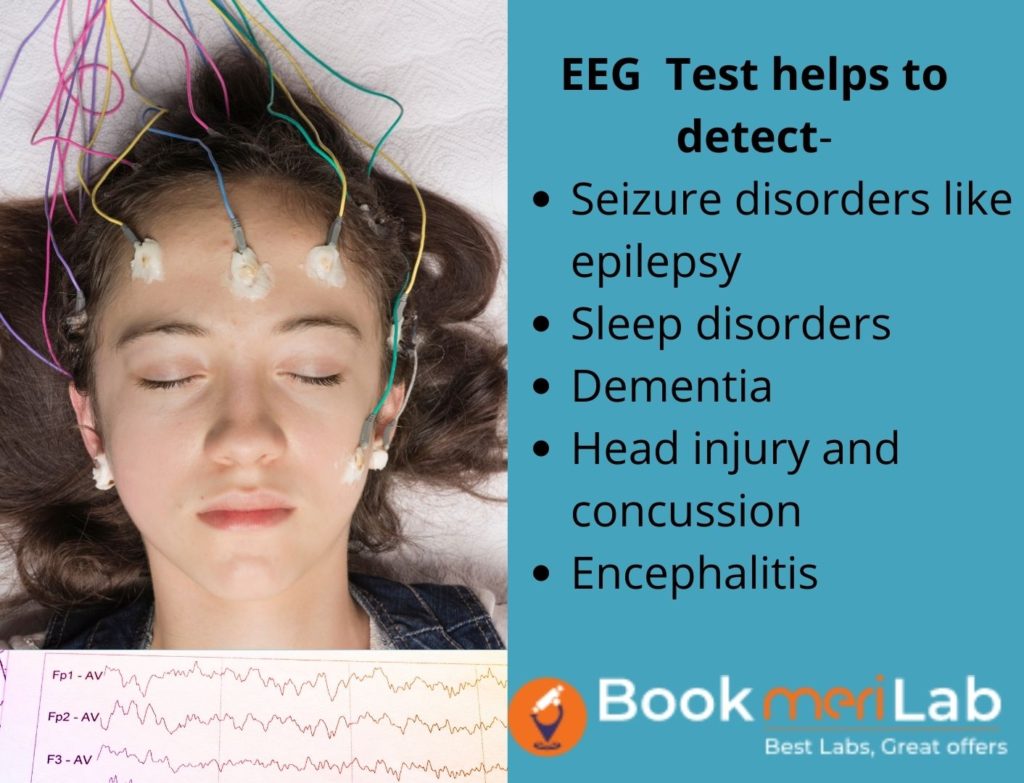
An EEG test measures electrical movement and impulses. These are helpful in diagnosing health problems related to our brains. Some disorders which can be detected are
- Seizure Disorders
- Sleep Disorders
- Strokes
- Memory Problems
- Dementia
- Encephalitis (Inflammation of the brain)
An EEG can also be used to confirm brain death in patients who have been in a coma for a long time.
A continuous EEG may also help find the right level of anaesthesia for someone in a medically induced coma.
EEG Test Procedure
EEG test procedure is a simple, painless and non-invasive test that doesn’t involve any risks. The step-by-step procedure is explained below.
- The process starts with the preparation of the scalp by scrubbing the areas marked for electrode placement.
- The electrodes are themselves placed inside tiny elastic caps.
- These electrodes (about 16 to 25) are then placed over the scalp so that identical information is collected from all areas of the head. The number is usually at least 19 but may be lesser for neonates.
- The electrodes are connected to wires which are further connected to a computer.
- The electrodes monitor the electric frequency of the cells inside the brain.
- The recordings are then projected on a computer in the form of waves.
- A doctor further studies these waves to diagnose any related disorders.
The procedure may vary depending on the type of EEG.
Duration Of An EEG Test
Once electrodes are placed on the scalp and the whole setup is connected to a computer and ready to go, the process usually takes an hour. The patient would have their eyes closed most of the time during the procedure. It is a really easy and quick procedure. If performed under 24-48 hours from the last seizure.
What To Expect After An EEG Test
After the EEG test is completed, the technician will remove the electrodes placed on the patient’s scalp. The patient will have to remove the sticky material on their head that was used to paste the electrodes.
No recovery time is needed, and the patient can head back home as soon as the test is completed. The patient is advised not to drive back home as there are chances of having a seizure. Once home, the patient should take a rest and not do any strenuous activity.
Types of EEG
Routine EEG
It takes about 20-40 minutes to perform this test. During the routine EEG test, the technician or the doctor may tell the patient to sit quietly. The patient may also be asked to repeatedly close or open their eyes, take deep breaths for a few minutes (hyperventilation), or even put flickering lights in front of the patient to stimulate the senses. This may cause slight discomfort for the patient but is not harmful.
Sleep EEG
It may be needed when the routine EEG does not give adequate information or in cases of sleep disorders. The patient may be advised to stay awake the night before so they can easily sleep during the test. Sedatives may also be given to induce sleep.
Video EEG
It is also known as video telemetry. In this test, a video recording of the patient is also made along with the EEG recording to obtain additional information about brain activity. This test is usually recorded over many days. The EEG signals are transferred to the computer wirelessly. The video recording is also available on the computer and is under constant surveillance of a trained professional.
Ambulatory EEG
It records brain activity throughout the day and night over one or more days. The electrodes are attached to a portable recorder that may be clipped to the patient’s clothes. The patient may continue their day as usual but must not get the equipment wet.
Invasive EEG Telemetry
This is not commonly performed. It involves surgery to place the electrodes directly on the brain to determine the exact origin of the seizure. It is done in complex cases of epilepsy.
EEG Test Precautions
- Caffeine consumption should be avoided on the test day as it may hamper the test results.
- Continue your prescribed medication unless the doctor has suggested stopping.
- You should properly wash and clean your hair before the test.
- Do not apply hair products such as gels, oil, or conditioners before the test as it may make your hair non-sticky, and the electrodes may have difficulty sticking to your scalp.
EEG Test Risks
EEG tests mainly do not pose any risks. The electrodes are placed to record the ongoing activity inside the brain and not cause any significant discomfort. As this test is non-invasive, it is safe to conduct.
Hyperventilation (to take quick deep breaths) which is usually induced in some patients to produce abnormalities in EEG, may not be safe in patients with a history of stroke, sickle cell anaemia or asthma.
There may be a risk of seizure in some patients due to flashing lights or other factors, but it can be easily managed by the professionals conducting the test.
Results
The result usually comes after a few days from the day of the EEG test. The readings of the EEG test are studied by a neurologist who checks for any abnormal readings. Any result with a frequency of 8 Hz and higher comes under normal outcomes of any EEG Test. With the help of EEG, even the specific area where there is an abnormality in the brain can be found. Depending on the results, a doctor may also recommend an MRI brain.
Sample Report
Below is a sample report.

Age-Specific Advice for EEG Test
EEG tests are safe for everyone – babies, kids, adults and the elderly. But the test and what doctors look for might vary slightly, depending on the age. Let’s understand how:
EEG for Children
Reasons Why Because I can, doctors do EEG for children to:
Seizures or epilepsy
Delays in growth or learning
Sleep problems
Behavioral issues (such as autism or ADHD)
What’s Different:
- Children may have a hard time staying still, so the test itself may be shorter or be performed in pieces.
- Toys, cartoons or other diversions could help keep the child calm.
- Some children may need to sleep for the test ( sleep EEG ).
- If necessary, mild medication is administered to calm the child.
Tips for Parents:
- Before the test, wash the child’s hair (no oil or gel).
- And if it’s a sleep EEG, try to keep your child up past bedtime the night before the test.
- Carry snacks, toys or a favorite blanket to soothe.
EEG in Elderly People
EEG helps doctors identify memory loss or dementia when examining older patients.
Memory loss or dementia (like Alzheimer’s)
- Seizures or stroke-related problems
- Sudden confusion or behavior changes
- Parkinson’s or similar diseases
What’s Different:
- The aging process causes the brain to slow which results in altered EEG readings.
- The elderly population requires additional time along with supportive measures to comprehend instructions.
- Doctors take into account the fact that patients could have additional health problems or be on multiple medications when evaluating their test results.
Tips for Family Members:
- Ensure they receive their routine medications when it is permitted by their doctor.
- The technician needs to be informed if they possess any difficulties related to mobility, auditory perception or memory.
EEG for Newborn Babies
Newborn patients in the NICU receive EEG as a diagnostic tool to:
- Check for seizures
- Look for any brain problems after birth
- Monitor brain development
What’s Different:
- Very gentle test using soft, small wires
- Medical professionals conduct this test in a serene environment such as the NICU.
- Healthcare providers can monitor brain activity for several hours or even multiple days if necessary.
Conclusion
The application of EEG tests has broadened over the years. Its history can be traced back to WW2, when pilots were screened in and out depending on their chances of having a seizure. EEG tests can detect changes up to a millisecond, and their utility in the clinical field has significantly increased over the years. There are other diagnostic techniques, such as CT scan head or MRI brain, which a doctor may recommend to further substantiate the findings of EEG.
FAQs
An EEG is primarily used to detect epilepsy which is a seizure disorder. It can help determine the type of seizure and its triggering factors which enables the doctor to better manage the disease.
No. EEG is a non-invasive and painless procedure. The electrodes do not produce any sensation and hence no discomfort.
An EEG test usually takes 30-60minutes. Some EEG tests may take longer depending on the procedure requirements.
Yes you can eat normally before an EEG test. However, for about 8-10 hours before the test, please avoid caffeine.
Since the EEG recording cannot be read on the spot by the EEG technologist but needs to be analysed by a neurologist, it may take anything between 2-7 days depending on your diagnostic center and city. In some cases the results may take less than 48 hours.
An abnormal EEG indicates abnormal activity in some area of brain. This can happen due to conditions like epilepsy, stroke, sleep disorders, dementia, etc.
How to Book an EEG Test?
Dr Garima Saroj
Dr Garima Saroj is a dentist from Manipal college of dental sciences. She has previously worked at ESIC dental college and hospital Delhi and Dentecare multispecialty dental clinic Gurugram. She has a passion for writing for patient education and awareness.
November 9, 2022 @ 5:59 pm
Kailangan pa po bang mag pa schedule sa EEG tnx po
Kahit may request ng doctor po…